Not sure what you have? Describe it on the phone. Free, no-obligation estimates, and we call back the same working day.
The short answer
The Main Types of HVAC Systems
The main types of home HVAC systems are split systems, package units, ductless mini-splits, heat pumps, wall furnaces and boilers.
They differ in where the equipment sits, whether air moves through ducts, and whether one system does both the heating and the cooling. The system types are listed below.
Split system
Ducted, in two halves
Package unit
Ducted, in one cabinet
Ductless mini-split
No ductwork needed
Heat pump
Heating and cooling in one
Wall furnace
Gas heat from the wall
Boiler
Heat carried by water
Split Systems: Indoor Coil and Outdoor Condenser
A split system, also called direct expansion, has an evaporator coil inside the home and a condenser outside.
The "evaporator coil" is the indoor coil that absorbs the heat, and the "condenser" is the outdoor unit most people simply call the outside unit.
Inside
Evaporator coil
Outside
Condenser
Air moves by
Ducts and vents
Package Units on Roofs and Pads
A package unit puts the heating and cooling components in one outdoor cabinet, usually on a roof or a concrete pad.
You may hear it called a rooftop unit or an all-in-one unit. With both halves in one box outside, the house keeps only the ducts and vents it feeds.
Inside
Ducts and vents only
Outside
One cabinet with both halves
Sits on
A roof or a concrete pad
Ductless Mini-Splits
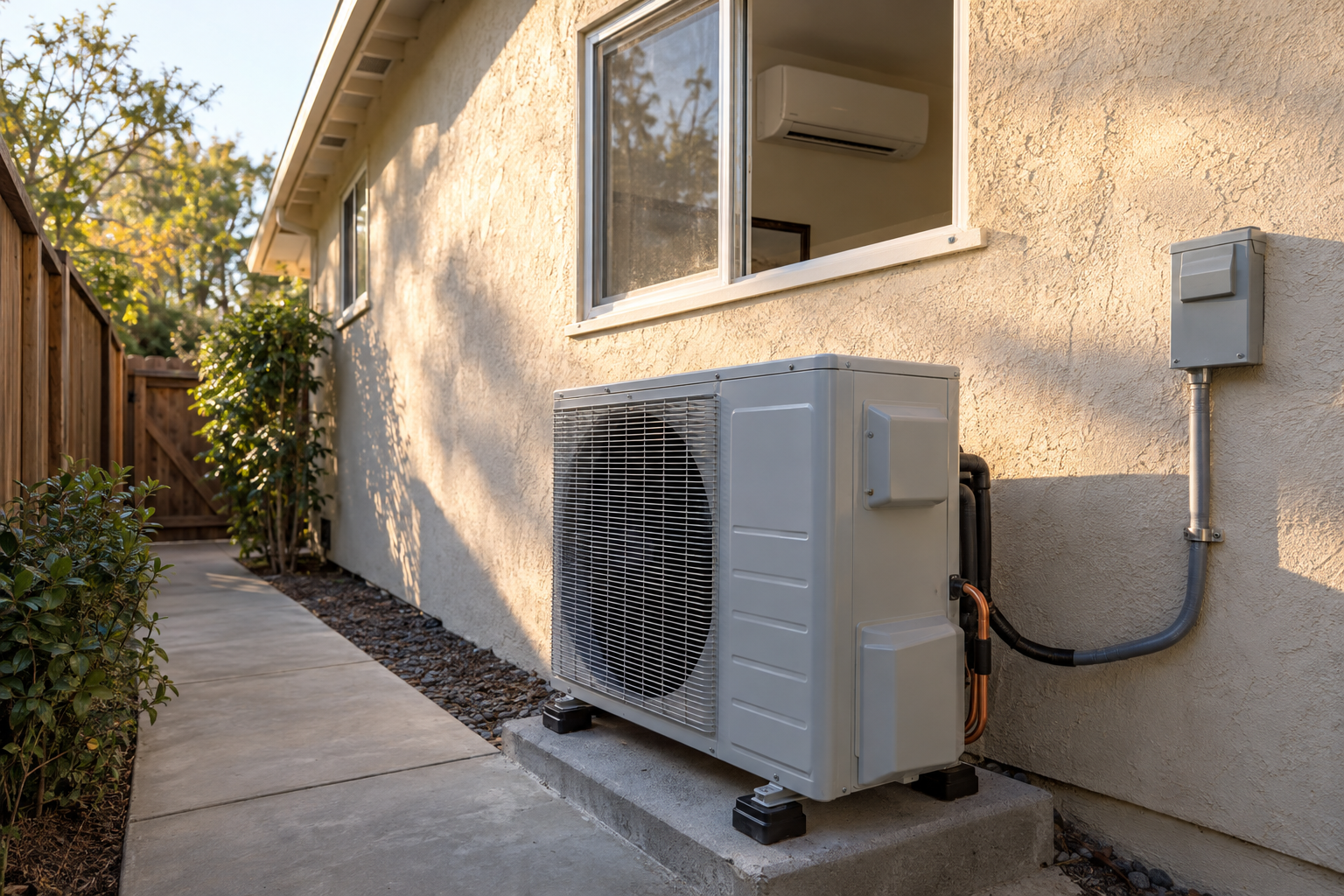
A ductless mini-split has one or more indoor heads, an outdoor condenser, and refrigerant line sets that pass through a small hole in the wall.
It is the system people mean by a wall unit or ductless AC, and it is used where the home has no ductwork.
A heat pump uses a "reversing valve" to change the direction the refrigerant flows, so one system either heats or cools the house.
An air conditioner only carries heat out of the rooms. A heat pump runs the same refrigerant circuit both ways, and the valve decides which way it goes. When a heat pump gets stuck in one mode, that valve is one of the first parts we check.
Refrigerant picks up heat at the indoor coil and carries it out to the outdoor unit.
Reversing valve turns the flow around
Heating
Flipped for winter, the same circuit runs backward and warms the house.
Heat without forced air
Wall Furnaces and Boilers
A wall furnace heats a room from a gas burner set into the wall, and a boiler heats water and sends it, or steam, to radiators instead of blowing air through ducts.
You may know them as a "wall heater" and as radiator heat or hot water heat. Both are heat-only systems, so a house that has one cools some other way.
A gas or electric heater set into the wall of the room it heats, common in older homes. Its working parts include a gas valve, thermocouple components, a thermostat and a gas orifice.
Boiler
Heats water in a sealed system and sends hot water or steam to radiators, baseboard units or in-floor tubing.
Side by side
Comparing System Types
The types differ in whether they need ducts, whether one system both heats and cools, and where the equipment sits.
Set side by side, the system types compare like this.
System
Needs ducts
Heats and cools
Where the equipment sits
Split system
Yes
Cools; the heat comes from a paired furnace unless the outdoor half is a heat pump
Evaporator coil inside, condenser outside
Package unit
Yes
Yes, both in one cabinet
One outdoor cabinet on a roof or concrete pad
Ductless mini-split
No
Cools, and heats where the system is a heat pump
Heads on the wall inside, condenser outside
Heat pump
Either
Yes, the reversing valve switches modes
Outdoor unit with an indoor coil or wall heads
Wall furnace
No
Heat only
In the wall of the room it heats
Boiler
No
Heat only
Boiler with radiators, baseboards or in-floor tubing
Options for Homes Without Ducts
A home without ducts suits ductless mini-splits, a wall furnace or a boiler, since none of them moves air through ductwork.
The options for a home without ducts are listed below.
Ductless mini-split
Wall furnace
Boiler
Not sure which one you have?
Tell us what sits on the roof, in the side yard or in the wall, and what it is doing. We will tell you what the system is and book the visit.