
Repair or replace
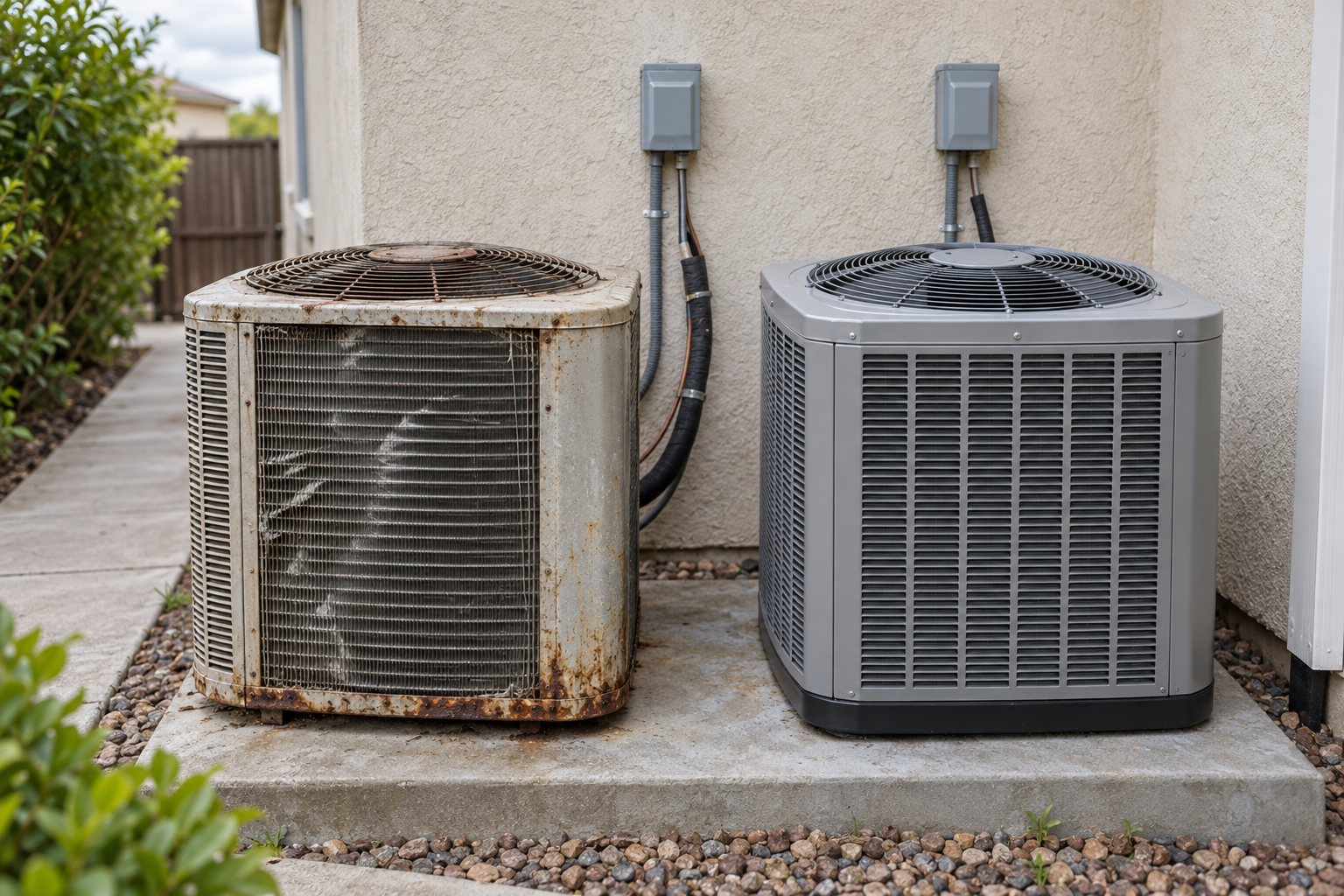
When to Repair or Replace an AC or Furnace
The system's age, the part that failed and the repair price next to a new system settle most of these calls. Here is how we weigh them with you.
Free, no-obligation estimates. We answer the phone or call back the same working day.
The short answer
The Three Factors: Age, Problem and Price
Whether a repair is worth it depends on the system's age, how bad the problem is and what the repair costs compared with a replacement.
None of those settles it on its own. A cheap fix on an older unit can still be the right call, and a costly fix on a young system often is too, so we look at them together.
Here is what each of them asks about your system.
Age
Counted from the install date on the unit, not from when you moved in.
The fault
A worn switch and a dead compressor are very different sizes of trouble.
The price
The repair quote set beside what a new system would run.
The usual thresholds
The Age and Half-Cost Rules
Replacement usually makes more sense when an AC is over 12 years old or a furnace over 15, and the repair would cost more than half of a replacement.
The trade reads the cooling and heating sides a little differently. On an air conditioner, the age and the price both have to point the same way. On a furnace, either one is usually enough.
These are starting points, and further down we explain why no cutoff fits every house.
Air conditioner
Over 12 years
and
A quote past half of new
Both together usually make a new system the better spend.
Furnace
Over 15 years
or
A fix priced above half a new furnace
Either one usually makes replacing the smarter move.
Worth fixing, or not
Repairs Worth Making on a Newer System
A capacitor, contactor or fan motor on a system under about 12 years old is almost always worth fixing, and a failed compressor on an old R-22 system usually is not.
Usually worth the repair
On a newer system, these parts are the cheap end of an AC repair.
Run capacitor
The usual reason an AC won't start while the outside fan keeps turning. It is one of the least expensive repairs there is.
Contactor
The switch in the outside unit, a low-cost electrical part.
Fan motor
Costs more than a capacitor, and on a younger system it still earns its keep.
Usually points to replacement
On an older system, these faults usually tip the decision.
Dead compressor in a Freon unit
The compressor is among the most expensive AC repairs, and R-22 behind it is scarce and costly to recharge.
Cracked heat exchanger
A crack can leak carbon monoxide, and it usually means the furnace should be replaced.
Refrigerant and repeat calls
Refrigerant Type and Repeated Breakdowns
A system that is 10 or more years old, runs on discontinued R-22 or keeps needing repairs is often better replaced.
R-22, the "Freon" in older air conditioners, was phased out in 2020 and is now scarce and expensive; the U.S. EPA sets out that phaseout. Any repair that opens the refrigerant side of an R-22 system carries that cost with it.
Newer R-410A systems can still be kept and serviced, but R-410A supply is shrinking and its price per pound rises every year, which matters when a large repair is on the table. And when the same unit keeps needing work, those bills add up toward the price of a new one.
Signs to price both options
Any of these on your system is a reason to hear both numbers.
- A decade or more of service behind it
- Still charged with the old "Freon"
- Repair after repair on the same unit
Your home, your call
Why No Single Cutoff Fits Every Home
No single age or repair-price cutoff fits every home, so the rules above are a starting point for the decision rather than the answer.
A well-kept older unit with a cheap fault, a newer system with a costly one, a house where the ductwork can or cannot be reused: each tips the math its own way. What we can do is put the repair price in front of you, and the cost of a replacement when it is close, so you decide with real numbers.
Weighing a repair right now?
Call and tell us the system's age and what it is doing. We quote the whole job before we start, with no surprise charges after.
Before you approve the work
The rules only work once you have a diagnosis and a clear quote in hand. This is what to ask for.
Questions to Ask Before You Replace an AC
Before you decide, you should get the scope, the price, any diagnostic charge, parts availability and the repair terms for the repair you are weighing.
Ask for each of these before you say yes.
- ScopeWhat the repair covers, part by part.
- PriceThe whole job, quoted before any work starts.
- Diagnostic chargeWhether there is one, and whether it is credited toward the repair.
- Parts availabilityWhether the part is on hand or has to be ordered.
- Repair termsWhat stands behind the work once it is done.
Getting an AC Repair Diagnosis First
The decision starts with a diagnosis that names the failed part and the repair price.
The technician inspects the equipment and the conditions tied to the problem you describe, not just the unit, and confirms the fault before naming a part. With the part and the price in hand, every rule on this page has something real to work with.
AC Repair in BellGoogle reviews
Neighbors on the work and the price
Our Google reviews, exactly as the customers wrote them.
Great service at a great price. Very nice and respectful too.
They did a great job. Javier and his team are very professional and courteous and respectful. I definitely recommend them. They saved us thousands
They did fantastic job at a great price. Javier And his team were really professional and super nice. Appreciate the great work they did!👊🏾😎
Not sure it is worth fixing? Call us first.
Tell us how old the system is and what it is doing. We find the failed part, give you the price, and you decide with the numbers in front of you.
Free, no-obligation estimates, and we show up when we say we will.